


Day of the year: 286
Calendardate: October 13
Timeline. Map. Go to today’s Bible reading (use your browser arrow to return): Mark 6:12-44; Matthew 14:1-21; Luke 9:6-17; John 6:1-15
Empathy and Compassion
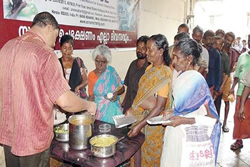
All around the world, there’re calamities. These calamities may take the form of hurricanes, floods, fires, or even famines. Do we have compassion in our gut for the homeless, persecuted, sick, tired, or hungry? Would we be hospitable and give whatever comfort we could, or would we just send them away? Jesus empathizes with people and helps them.
In today’s Bible reading, John the Baptist is in prison, being persecuted for taking a stand against immorality. Herod Antipas, the ruler of Galilee and Perea, had married his brother Phillip’s wife (Herodias). Apparently, this was unlawful even for the Romans. Out of anger against John’s condemnation, Herod’s wife, Herodias, waited for an opportunity to have John killed. That opportunity came on Herod’s birthday.
Herodias had a daughter who pleased Herod with her dancing so much he foolishly promised to give her whatever she wanted. Advised by her mother, Herodias, she asked for the head of John the Baptist.
Just about the same time the Lord is told about John’s execution, the twelve apostles return from their mission and give him a report. They're tired and need rest and refreshment. They grieve with Jesus when they are told about John the Baptist.
Compassion may Stretch Us to the Limit
Jesus and his disciples go to a solitary place to get away for a while, but the crowds follow them. They’ve always got needs, and always, they want his attention. The people don’t know about Jesus’ grief about John or that his disciples are tired from their ministries. They’re focused on getting Jesus to help them with what they need.
People sometimes make demands of us, even when we're drained of strength. What do we do? If we can, we try to get to a solitary place to pray and be refreshed. Sometimes, we need to get away from stress. If we don’t come apart, we’ll come apart.
The crowds following Jesus see him and his disciples get into a boat, so they walk around the Lake of Galilee and meet them on the other side. Does Jesus get mad and tell the crowd to go away? No, he doesn’t. Instead, Jesus has compassion on the multitude. Although tired and grieving, he heals their sick and teaches the people. What a day! Sometimes, God will stretch us to the limit, and we must pray and rely on his sustaining grace.
The Feeding of the Five Thousand
Later, the disciples wanted to dismiss the crowds so they could get something to eat. The multitudes have traveled far and are exhausted and famished. Jesus sympathizes with them. Should he send them away hungry? No. He tells the disciples to give them something to eat.
The disciples are dumbfounded. There’re 5,000 men plus women and children, and all the disciples can scrounge around and find is a boy’s lunch of five loaves and two fish. The small meal is hardly enough to feed the twelve apostles and Jesus, let alone the enormous crowd. If they give the food away, what will the disciples eat? How can they possibly feed all the others?
Jesus tells them to take what they have and distribute it to the people. A miracle occurs as portions are served; the food increases. That day’s meal feed everyone, leaving twelve baskets of bread and fish, a basket for each disciple.
What can we learn from this miracle? First, God wants us to exercise compassion, even when we're stressed. For instance, moms and dads come home tired, and yet their spouse or children have emotional or physical needs that must be met. Perhaps, they had a tough day at work or school, and although we’ve had a challenging day, too, we put that aside for their sake. They may be hungry, and although we’re hungry, too, we must meet their needs. They may need someone to listen to them, and even when we’d rather not, we must put aside our desire for quiet and give them undivided attention.
Second, although we’re not promised miracles, God can do things with what we have if we will give it. The Apostle Paul would later assure us, “...my God shall supply all your need according to his riches in glory by Christ Jesus” (Philippians 4:19, KJV).
Third, Jesus gives thanks to God for the food which is found and then gives it away. Do we keep what we have, or are we willing to give it away? By giving away the small portion of food, not only is Jesus’ compassion shown but also God’s power is shown so that people will believe. This is grace-giving. The Apostle Paul instructs us
Each man should give what he has decided in his heart to give, not reluctantly or under compulsion, for God loves a cheerful giver.
And God is able to make all grace abound to you, so that in all things at all times, having all that you need, you will abound in every good work. As it is written: “He has scattered abroad his gifts to the poor; his righteousness endures forever.”
Now he who supplies seed to the sower and bread for food will also supply and increase your store of seed and will enlarge the harvest of your righteousness. You will be made rich in every way so that you can be generous on every occasion, and through us your generosity will result in thanksgiving to God. (2Corinthians 9:7-11, NIV)
Discussion
Is showing empathy and compassion always easy? Why or why not?