

Psalm 92; The LORD Forever Exalted
Recommended Procedure. Timeline. Map. Go to today’s Bible reading.
Idea for the Bible teacher or discussion leader: Have a discussion about what could or should be included in the service of a church or worship center.
Getting Ready
Today, we are studying Psalm 92 which occurs in the fourth collection of the Psalms (#90-106).
Go to today's Bible reading and read Psalm 92 ten times. Try reading it and/ or listening to it in different versions. This will help you understand the overall context of the Psalm and how it might be divided.
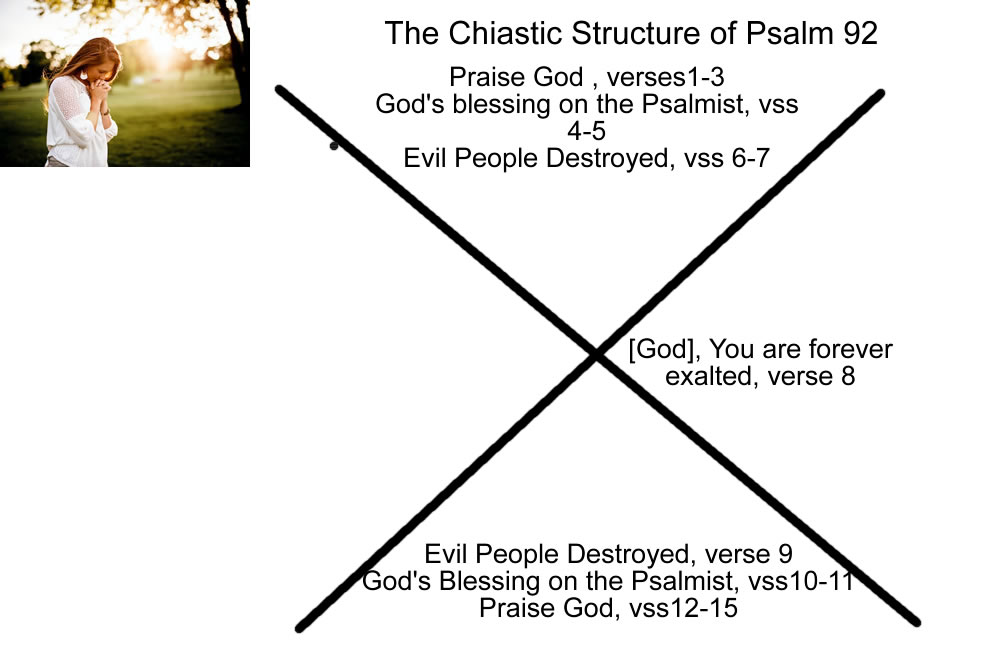
biblehub.com describes Psalms 92 as having a chiastic structure. In summary, this means the format is a letter X; the first and last part of the Psalm are mirrored, and there is a central point. We need to keep this in mind as a key to interpreting this Psalm.
Looking at Psalm 92's structure, what things are mirrored and what is the central point?
Now, let's dig a little deeper.
Observing significant things in a passage.
Words. If a word is repeated over and over, it's probably important. It can indicate a theme, who the audience is, an important person or position, or help us determine the context of a passage. What word or words are repeated and how many times? What questions do you have about them?
Types of Psalms Review the different types from the introduction. Which one closely matches the kind of Psalm here? How might this influence our interpretation?
Audience. To whom was this Psalm addressed?
If you were to give this Psalm a title, what might it be? Don't worry, just a title expressing the theme is sufficient. No right or wrong answers here.
Now that you have a temporary title, what might be the subtitles, the sub themes?
Reread verses 1-3 which I have termed The Psalmist Exalts God. How can we praise God according to these verses? Based on this answer, who might be the composer of this psalm?
Psalm 92:1-3
It is good to praise the LORD
and make music to your name, O Most High,
proclaiming your love in the morning
and your faithfulness at night,
to the music of the ten-stringed lyre
and the melody of the harp.
The poetic form in these verses is symmetric, i.e. the subject of the couplet is referring to the same thing in the second verse as the first. Which phrases are those?
Why is it good to praise the Lord and make music to the Lord in the morning and at night? How might we apply these verses in our own life?
Why might it be good to sing to the Lord most high, proclaiming the Lord's faithfulness in the morning and his goodness at night to the music of the lyre and harp? Of what value are the instruments?
Psalm 92:4 continues the thoughts of verses 1-3
For you make me glad by your deeds, Lord;
I sing for joy at what your hands have done.What deeds of the LORD can we be glad about and sing for joy?
Psalm 92:4-5
For you make me glad by your deeds, Lord;
I sing for joy at what your hands have done.
5 How great are your works, Lord,
how profound your thoughts!What deeds of the LORD make us glad and make us sing for joy?
What great works and profound thoughts about God do we think about?
Psalm 92:6-7
Senseless people do not know,
fools do not understand,
that though the wicked spring up like grass
and all evildoers flourish,
they will be destroyed forever.But you, Lord, are forever exalted.
Senseless and foolish people in this context are the same. What are some things they pursue but don't understand? What should they understand?
In the chiastic style of this song, the "LORD is forever exalted" is the hinge point, the center point of the x. Read the whole Psalm again. You will notice things are repeated in a similar form, but David, the Psalmist, is more specific in the second half of the Psalm.
Senseless people in verses 6-7 refer to what in verse 9?
God personally doing good deeds and great works for the composer, verses 4-5, refer to what in verses 10-11?
Worshipping God in verses 1-3 refer to what in verses 12-15?
Now, we will move onto the second half of this Psalm, vss. 9-15. The chiastic form is the same, but the details help us know the context a little better. In verse 9, why do you think the composer writes "surely your enemies" twice?
Verse 9 contains a parallelism. What kind is it, and how might it affect our interpretation?
In verses 10-11 the psalmist says, You have exalted my horn[b] like that of a wild ox;
fine oils have been poured on me.
11 My eyes have seen the defeat of my adversaries;
my ears have heard the rout of my wicked foes.Consider these comments before you answer these questions.
1. Did you notice a change in pronouns? Now the composer of this psalm is giving personal thanks in his praise to God.
2.Horn in the Bible is a word that means leadership, like that of a general, captain or king. The "oil poured on me is anointing oil." In the Bible, priests and kings were anointed with oil, symbolizing being set apart for God's service and assignments.
From these verses, who do you think the composer was? What good things have happened to him to praise the LORD?
What good things have happened to you to praise the LORD?
Psalm 92: 12-15 is one thought.
The righteous will flourish like a palm tree,
they will grow like a cedar of Lebanon;
13 planted in the house of the Lord,
they will flourish in the courts of our God.
14 They will still bear fruit in old age,
they will stay fresh and green,
15 proclaiming, “The Lord is upright;
he is my Rock, and there is no wickedness in him.”What does it mean, the righteous will flourish like a palm tree and grow like a cedar of Lebanon?
If you were to give a summary and spiritual application to this Psalm, what would it be?
Today's Focus Verses:
Psalm 92:8 But you, Lord, are forever exalted.
Write a private prayer response to today’s Bible study:
Please send your comments to me, Rod, (the author)
Back to top of page
Back to Bible Study Menu
Go to Home pageAnswers: (use browser arrow to return to previous spot in Bible study)
Structure of Psalm 92:
A1: Repeated words: LORD, you, my, righteous, evil-doers
Audience: Since this song is for Sabbaths, we assume this was a Jewish audience
Type of Psalm: Worship
A2: A title might be God is Worthy of Worship
Subtitles could be:
The Psalmist exalts God
God blesses the righteous
God destroys the wicked
God destroys evildoers
God blesses the righteous
The Psalmist exalts God
A3: Making music to the LORD. The composer used a ten-stringed lyre and the harp. David. the son of Jesse and future king of Israel played the lyre and harp, so maybe he was the composer. Comparing the style of known Davidic psalms with unknown Psalms may give us the answer.
A4: Verse 1: praising the LORD is equated with making music to him.
Verse 2: love in the morning and faithfulness at night. Love and faithfulness are equated.
Verse 3: a ten stringed instrument and a lyre are both expressions of a harp
Your own answers to why we should praise the Lord in the morning and at night.
My answer: Proclaiming the Lord's praises in the morning sets the tone for the day, and at night, reflecting on the goodness of God, and sharing it with others encourages faith and gives us peace to help us sleep. This is much better than worry and complaining.
My answer: Perhaps they set the mood. Maybe God even likes to hear these instruments.
A6: God's salvation is an obvious choice, but we can also be glad about his creation or answered prayers. What has he done in your life recently?
A7: Your answers about God's deeds and works.
Here are some thoughts about God's thinking that blows me away.
God created the universe but desires a personal relationship with his creation, you and me.
God's thoughts toward us are like the sand of the sea in number. He never stops. He loves and cares for us with compassion and righteousness.
God is patient and longsuffering, often allowing people who have a relationship with him a lot of time to repent from evil deeds so he can renew his relationship with them and bless them. He doesn't want to keep disciplining us, but he will if it's necessary.
God is good to all, even the wicked. He often doesn't punish them right away.
God sent his Son Jesus to save sinners. We deserve to go to hell for our sins but God is loving, merciful, and gracious.
God is patient with us through all our failings. Every day his arms are open to forgive and restore us.
God chooses to use us to accomplish his will, and he gives us each assigments. The assignments are always challenging. He uses us for his glory and our sanctification, and to minister to others or save them. This is always challenging. Sometimes it's scary. Often times it is difficult. Are we doing it or complaining? God will shape us. We are his masterpieces, so he will chip away at us until we are what he wants us to be. Then, at the end he will reward us for faithfulness. Some will even rule and reign with Christ.
What are your God thoughts?
Senseless, foolish people don't understand that there is an end to this life, to all their nonsense and evil deeds, and only those who have a personal relationship with God will not be destroyed. And, in a probable reference to hell, the text says they will be destroyed forever.
Only those who are worshippers of the true God of heaven will flourish and have eternal life. Only those who are followers of God realize that a vibrant relationship with him bring purpose and value to their life, and his blessings. God is worthy of our time and attention. To him be all praise forever.
Which life are you choosing?
A8: Senseless people in verses 6-7 refer to what in verse 9? The wicked . The LORD is exalted by the destruction of the wicked. It proves his justice.
God personally doing good deeds and great works for the composer, verses 4-5, refer to verses 10-11. Here, the composer exalts the LORD for his personal care over those who are righteous, particularly himself, who is probably King David. God's great deeds are lifting up David's horn. Horn in the Bible refers to leadership and military might (like a wild ox). The LORD blesses the righteous. This refers to his victory to all who were enemies to the crown, and this would include his treacherous son, Absalom. "Fine oils poured on me" likely refers to David's anointing, his return to the throne.
Worshipping God in verses 1-3 refer are explained in verses 12-15: David exalts the LORD in praise. David says. even as he gets older, even after he's made some serious mistakes, the LORD has forgiven him, and made his kingdom flourish once again. He can do the same for you, my friend.
A9: Here is an answer from AI. I think he nailed it. Surely, Surely" communicates a strong conviction. Surely, it is your enemies, LORD, that will perish (not the righteous ones)
A10: the phrases, "enemies will perish" and all "evil doers will scatter" could be a synthetic parallelism. It seems to be identical in meaning with some added information. Perhaps, the author of this psalm means that God's enemies will perish (be scattered) as a nation. You might want to pray for our nation at this time that we will repent so we are not scattered as a people through war or famine .
A11: I think the composer is King David, and his enemies were those who conspired with his son, Absalom to seize his throne. But God made his horn, David, strong like a wild ox to destroy his enemies and return him to his throne, the place God had anointed him.
Personal answers: I am thankful for God defeating Satan and giving me strength during extremely trying times. I trust he will bring us to win soon. Until then, I will persevere and comfort the troops (my family members).
A12: AI gives this good commentary: Palm trees flourish in warm, sunny climates with deep roots, symbolizing resilience and abundance, often flowering in late spring/early summer (May/June) and bearing fruit for decades; in a spiritual sense, they represent those rooted in faith who thrive through challenges, growing stronger and bearing fruit even in old age, as described in Psalm 92:12.
Key Characteristics of a Cedar of Lebanon
- Majestic & Stable: Known as the "king of trees," offering a sense of permanence and grandeur.
- Strong Roots: The Hebrew word for cedar implies firmness, highlighting deep spiritual roots in truth.
- Tall & Wide: Can reach great heights (120+ feet) with extensive, horizontal branches, showing outward growth and influence.
- Long-Lived: Cedars are incredibly durable and can live for centuries, symbolizing enduring faith.
- Evergreen & Healthy: Stays green year-round and produces a natural oil that resists disease, representing lasting vitality.
- Protective: Their strong wood has historical uses, and spiritually, they signify divine protection and purpose.
Spiritual Application (Psalm 92:12-15)
- Flourish like the Palm: A parallel image of being upright and fruitful.
- Planted in God's House: Growth comes from being rooted in faith and God's presence.
- Fruit in Old Age: A sign of a life well-lived, still producing good works and declaring God's faithfulness.
We exalt (praise God) who sees us and helps us. Those who cause us trouble and pain will not endure, but the righteous will thrive in his spiritual life, so he can share what God is doing. We need to study his word, obey his commands, and he will bless us. Praise be to his name.
Use browser arrow to return to previous spot in Bible study

About Us | New Bible Studies | FAQ's | Web Links | mobile app 
COPYRIGHT © 2025, Chronological Bible Studies